Phathry25 wrote:I understood it interpolated between points, just did a crappy job of explaining that.
So if I only set my friction to
friction 1.0 2.0
I would always have a friction coefficient of 1.0 even after the tire started slipping? The only change in grip is due to the load being applied to the tire?
I think the problem with the slip speed model is that the friction doesn't scale with the speed. So if the bike is going 100 f/s and the tire is slipping at 2f/s it's not a big deal. But if the bike is going 10 f/s and the tire slips at 2 f/s it's a show stopper. Hence why we can't climb up a hill at slow speeds. It leaves no room for error. If you were to compare to the slip percentage model that's either 2% or 20% slip, two drastically different numbers, but in MX sim it's the same thing.
Or no?
Even worse, when the bike isn't moving but the tire is spinning the slip percentage is infinite! Infinite is an even more drastically different number!
Jokes aside, I had assumed slip percentage was to model tire flex, not friction. If you imagine applying a lateral force to a stationary wheel, it will flex the sidewall a bit but not result in any sustained motion. But if you do that while the tire is rolling, it'll creep sideways as it flexes the relaxed parts of the tire as they touch the ground and the flexed parts leave the ground. As the tire rolls faster you'll get more creep. It's hard for me to see a rationale for anything else keying off of rolling speed. Why and in what way should the friction change?
cpt_Slow wrote:jlv wrote:I'm pretty sure the Greek letter μ originates from the Egyptian glyph for a cow, hence the slight resemblance of the character to a cow's head and the "moo" spelling and pronunciation.
Ahh you have misunderstood, the ancient Egyptians were famed for their appreciation for cats, so the pronunciation and spelling 'mew' is the correct one. The Greeks gave a little nod to this by making the character look like a cat walking on the ceiling.
By the way, I think even 'slight' might be too strong of a word there.
Well, you have to account for the way language evolves over the years. While the Greek letter "moo" may have looked like this:

The Phoenician version could have had more pronouced horns:

And obviously, an authentic Egyptian logogram uses an accurate depiction of a cow:
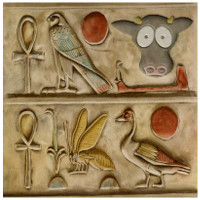

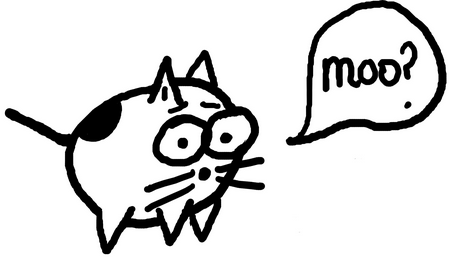
 .
.