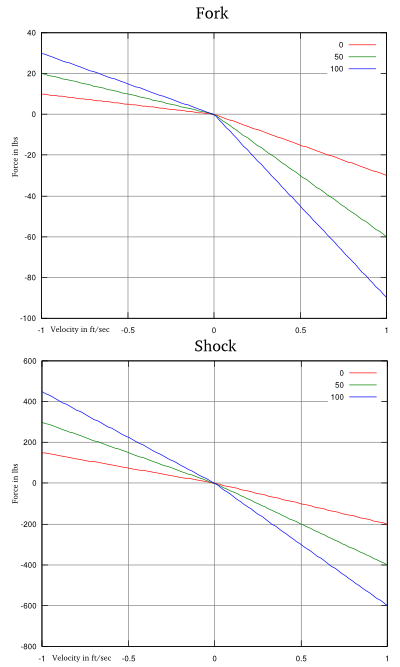
This should apply to MXS nicely. Let me know what you guys think.
Thumpertalk wrote:Adjust Your Dampening
You’ll be better able to adjust your suspension correctly if you first understand how it was designed to operate and can identify symptoms of incorrect operation. So let’s take a look at some of the…
BASIC PRINCIPLES
Preload and spring rate primarily affect how your suspension handles the big stuff, whereas dampening primarily affects how it handles the small stuff. But there is considerable overlap in who does what, so it’s a team effort. When they work together properly, you get both comfort and control over a wide range of riding conditions.
Compression dampening works with the spring to resist the wheel’s upward movement during a bump. In both the front and the rear suspension, for example, it helps the spring resist bottoming on big bumps, sharp rocks or deep whoops.
Rebound dampening works against the spring to resist the wheel’s downward movement after a bump. In the shock, for example, it keeps the rear spring from jamming the seat into your butt, and in the forks, keeps the front springs from pushing the bars into your face.
If they have not been adjusted to work together, the wheels bounce and slide rather than roll. And you get a lousy ride. Or crash and burn in the boonies. Too much compression dampening, for example, helps the spring too much, which produces a jarring, haphazard and uncomfortable ride over even the smallest rocks and bumps.
Too little compression dampening can also give you a “hard” ride if you have a “soft” spring -- especially if there is too much rebound dampening. The soft spring, and less-than-ideal compression dampening, allow the wheel to come up too much when it hits a bump, and the excessive rebound dampening keeps the wheel from returning to its “normal” position in time for the next bump. After a series of bumps, the suspension gets "stuck in a squat” with maybe an inch or two of travel.
This is packing, and shows its ugly face as harshness in the handlebars or side-to-side swapping of the rear wheel. Even with the correct spring.
Rebound dampening in the forks plays a major role in how well your bike corners. The compression of the springs during a turn “push” the wheel into the ground. The correct rebound dampening “holds” the spring’s rate of return so this “push” is maintained until the turn is completed. You front wheel develops good “cone effect” and your bike tracks through the turn smoothly and accurately.
Too little rebound dampening allows this “push” to get weak, then go away before the turn is complete. The wheel turns late or loses traction, and your bike turns wide or washes out. Too much dampening allows this “push” to be stronger and longer than necessary to complete the turn. The front wheel bites too deeply, and your bike turns early and inside.
Compared to your present settings, more dampening slows the wheel’s movement for a firmer ride, whereas less dampening speeds the wheel’s movement for a softer ride.
For both rebound and compression dampening, turn the clickers out (CCW) to decrease dampening and in (CW) to increase dampening.
***********
Even the most commonly accepted principles and rules of thumb should be tested in the real world of trial and error, revision and adjustment, so let’s take a…
TEST RIDE
Shock Rebound
Ride through rocks, roots or bumps leading into and out of a corner. If the rear wheel hops when braking for the corner or accelerating out of it, soften RD a few clicks and try again.
Ride over a log, ledge or rock. If the rear kicks up badly, stiffen RD a few clicks.
Ride through some deep whoops on hard ground. If your bike doesn’t track straight and the rear wheel doesn’t extend to the bottom of each whoop before the next one, or swaps badly, soften RD and try again. If that doesn’t help, stiffen CD a few clicks, and try again.
Shock Compression
Ride a trail with small rocks, roots and bumps. If the rear end feels harsh and bouncy, soften the CD. If it wallows, you’re riding the spring -- add CD.
Ride off your biggest jump. If your shock bottoms badly, add two clicks of CD. If it still bottoms badly, and your bike is not equipped with a Hi-Speed adjuster, try a stiffer spring.
Fork Rebound
Ride a short, sweeping turn. If your bike resists the turn, understeers, drifts to the outside, or the tire loses steering traction and washes out, add RD. If it oversteers, turns too quickly to the inside, or the tire bites too hard and knifes into the ground, decrease RD.
Fork Compression
Ride a trail with small rocks, roots and bumps. If the handlebars feel harsh, soften the CD. If not, add CD until they do feel harsh, then back off a click or two.
Adjustment Tips
Adjust the rider sag and check bike sag to ensure you’ve got the correct spring.
Check the pressure in both tires, and bleed the air pressure in both forks.
Use as little dampening as possible to get a “plush” ride, not a “soft” ride.
Small or smooth bumps want more compression dampening than big or sharp ones.
Hard trails want less dampening, and soft trails want more dampening
But sand requires very stiff settings – don’t be surprised if you max CW your clickers.
Use the Hi-Speed Adjuster for jumps, and the standard CD adjuster for bumps.
Improper riding technique can fool you into misadjusting your suspension.
You can make the wheel hop if you lock the brake or pull the clutch in a turn.
You can make your bike over or under steer with incorrect body position.
************
In the life of every problem, there is a time when it’s big enough to see but small enough to solve. So let’s take a look at a few solutions to some of the most common…
HANDLING PROBLEMS
Jarring => harsh ride in the handlebars on relatively small but sharp bumps
Decrease CD & RD so wheel comes up and goes down faster
Try a fork spring with a lower spring rate for a softer ride
Packing => harsh ride in handlebars on larger bumps
Increase CD in the forks to limit the compression
Decrease RD to help the wheel return more quickly
Try stiffer fork springs
Headshake => front wheel ocsillates side to side, especially in soft stuff
Move forks lower in triple clamps to increase rake and straight-line stability
Decrease RD in forks so wheel rolls over rather than ploughs into ground
Try stiffer front springs and softer rear spring to move center of gravity rearward
Oversteers => bike turns too quickly, goes inside the turn, front wheel knifes
Move forks lower in the triple clamps to increase rake, slow down turning
Decrease RD on both forks to slow down the turning
Install stiffer fork spring so wheel won’t sink in and bite too much
Understeers => bike turns too slowly, drifts wide -- front wheel pushes, washes out
Move forks higher in triple clamps to decrease rake and speed up turning
Increase RD on both forks to increase “cone effect” and speed up turning
Bleed air pressure in both forks to stop the front wheel from pushing
Try softer fork springs so wheel bites rather than pushes the ground
Kickup => rear wheel hops straight up, seat pops you in the butt
Increase RD to slow down wheel’s return after hitting a bump
Swapping => rear wheel hops side to side in hard to loamy whoops
Increase CD, and/or decrease RD to eliminate packing
Braking Hop => rear wheel hops excessively when braking for bumps or a corner
Decrease shock’s RD to help wheel follow the bumps more quickly
Acceleration Hop => rear wheel hops badly on rough ground during acceleration
Decrease RD to help wheel follow the bumps more quickly
If that doesn’t lessen the kickup, decrease the shock’s CD
Acceleration Spin => the rear wheel loses traction under heavy acceleration
Increase RD to improve rear wheel “squat”




 FRAUD IS A CRIME SAM!!!